

Russell 3000 Board Diversity Disclosure Initiative
Summary
Illinois Treasurer Michael W. Frerichs is leading an investor initiative calling on all companies in the Russell 3000 Index to disclose the makeup of their boards of directors – including gender, race, and ethnicity – given the correlation between board diversity and long-term performance.
Launched in October 2020, the initiative includes 26 investor organizations representing over $3 trillion in assets under management and advisement.
Treasurer Frerichs has been working to increase corporate board diversity since 2016, utilizing an array of strategies – including direct shareholder-company engagement, proxy voting, and public advocacy – to counter the unacceptably slow pace of change and ensure diversity is a corporate governance priority. The push for increased and standardized disclosure, at the center of this initiative, has been a focus of the Illinois Treasurer since 2019.

2021 Russell 3000 Board Diversity Disclosure Initiative Members
- Illinois State Treasurer Michael Frerichs (Chair)
- Connecticut State Treasurer Shawn Wooden (Co-Chair)
- Ariel Investments
- Boston Trust Walden
- Chicago City Treasurer
- Delaware State Treasurer
- Illinois State Board of Investment
- Impax Asset Management
- JLens Investor Network
- JUST Capital
- Legal & General Investment Management America
- Marquette Associates
- Meketa Investment Group
- Minnesota State Board of Investment
- New York City Comptroller
- Oregon State Treasurer
- Seattle City Employees’ Retirement System
- Segal Marco Advisors
- SEIU Master Trust
- SOC Investment Group
- Trillium Asset Management
- UAW Retiree Medical Benefits Trust
- Vermont Pension Investment Commission
- Vermont State Treasurer
- Wespath Benefits and Investments
- Wisconsin State Treasurer
About the Initiative
Members of the initiative share a concern about the relatively low number of women and persons of color on corporate boards, as well as the paucity of data on racial/ethnic diversity at the board level. Members also share the goal that leading American companies voluntarily disclose the racial/ethnic composition of their boards of directors, given the correlation between diversity and long-term outperformance.1
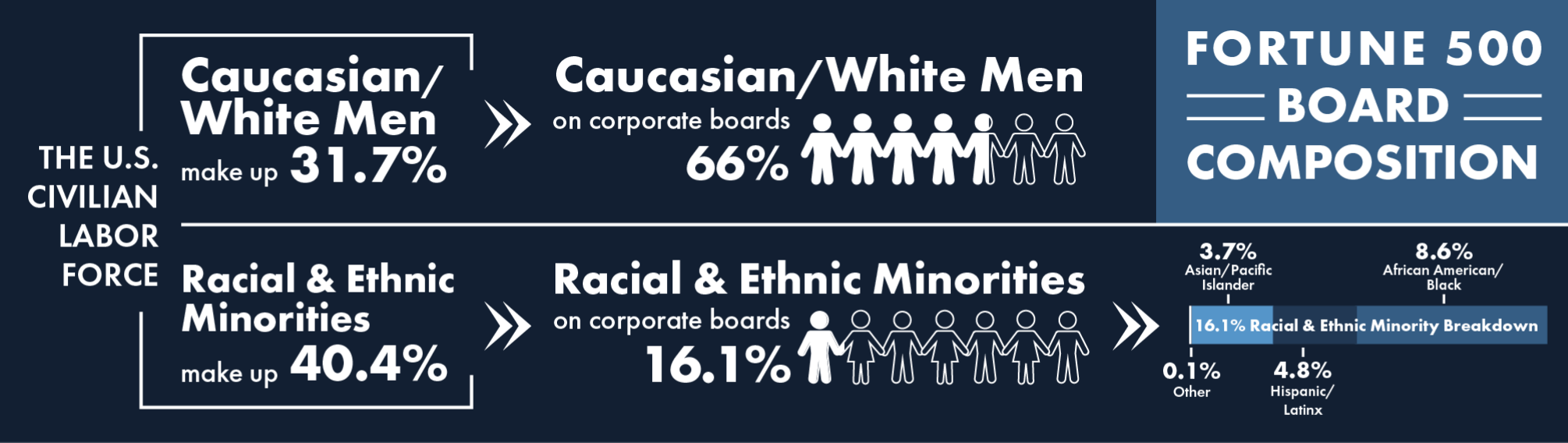
Advancing Racial, Ethnic, and Gender Transparency in Proxy Statements
Institutional investors, including the Illinois Treasurer, have helped advance gender diversity on corporate boards through proxy voting policies and direct engagement with companies. These strategies, now widely used by investors worldwide, have contributed to measurable progress. However, limited disclosure of racial and ethnic composition continues to make similar analysis more difficult and creates barriers for investors and researchers.
Following the murder of George Floyd, the national conversation around racial equity and inclusion intensified. Many companies responded with public statements and commitments related to racial justice. This initiative encourages companies to build on that momentum by disclosing the racial, ethnic, and gender composition of their boards of directors in annual proxy statements.
Annual Outreach to Russell 3000 Companies
In October 2020, Treasurer Frerichs launched the Russell 3000 Board Diversity Disclosure Initiative, which includes 26 investor organizations representing more than $3 trillion in assets under management and advisement. Each year, the investor coalition sends a letter to Russell 3000 companies, asking each to report the racial, ethnic, and gender composition of the board of directors in its annual proxy statement. In 2022, Frerichs’ annual letter to Russell 3000 companies was customized based on each company’s level of disclosure, grouped into three categories:
- Exemplary Disclosure: 386 companies (13 percent) were commended for providing exemplary disclosure, which includes reporting the race, ethnicity, and gender of individual board directors, often via a “Board Matrix.”
- Partial Disclosure: 1,847 companies (63 percent) were recognized for providing partial disclosure, which includes reporting the race, ethnicity, and gender of board directors in aggregate or for only certain members, and as such, are encouraged to enhance their reporting; and
- No Disclosure: 702 firms (24 percent) were urged to begin reporting as they neglect to disclose the race, ethnicity, and gender of board directors in public filings.
Using 2022 data from Institutional Shareholder Services (ISS), Frerichs found that more than 2,200 companies in the Russell 3000 now disclose the racial, ethnic, and gender diversity of their boards, either in aggregate or by individual director. That marks significant progress from 2020, when just 292 companies provided similar disclosure.
To explore the issue in more detail, read our White Paper on the Investment Case for Board Diversity.
You can also review example letters sent to companies as part of this initiative:
- 2020 Example Letter to Russell 3000 Companies (PDF)
- 2021 Example Letters to Top, Middle, and Bottom Performers (PDF)
- 2022 Example Letters to Top, Middle, and Bottom Performers (PDF)
For a timeline of the initiative’s progress, see:
- October 2020 Press Release Announcing the Call for Board Diversity Disclosure
- October 2021 Press Release Announcing the Second Wave of the Initiative
- November 2022 Press Release Announcing Progress to Date and the Third Annual Letter
This initiative aligns with the work of The Thirty Percent Coalition, a national organization that, in addition to advocating for board diversity, has called on companies to publicly disclose their board composition, inclusive of gender, race, and ethnicity. This initiative builds on the Coalition’s work by expanding this call to action to Russell 3000 companies. It also builds on the momentum of the Midwest and Northeast Investors Diversity Initiatives.
Members of the initiative either have or are examining policies to vote against nominating committees with no reported racial/ethnic diversity in their proxy statements and to expand more direct shareholder engagement. We find voluntary corporate reporting in the proxy statement to be the most reliable data source.
Contact Us
Should you have any questions or inquiries, please contact the Office of the Illinois State Treasurer at or MWVD@illinoistreasurer.gov.
[1] “Diversity Wins,” McKinsey & Company, 2020, available at: Diversity wins: How inclusion matters; “Why Diversity Matters,” McKinsey & Company, 2015, available at: Why Diversity Matters; David Rock and Heidi Grant, “Why Diverse Teams are Smarter,” Harvard Business Review, Nov. 4, 2016, available at: HBR.org.